Making the Nature Scene: A Conversation with Kim Gordon
Paris, 2024
Hugo Bausch Belbachir: The artists you have collaborated with, or are close to—I’m thinking particularly of Dan Graham, Jutta Koether, Mike Kelley, Reena Spaulings, John Knight, etc—all have, in a way or another, practices that apply to the porosity that forms between visual art, music, performance, theater, and cinema. Yourself, for almost forever, have had a presence in a music contexts—Sonic Youth, Free Kitten, Body/Head—in the foreground of also developing a practice in painting, writing, and film. How do you see the connections that arise from this? Or perhaps do you understand these contexts as independent situations from one another?
Kim Gordon: I think, within all those you just mentioned, that there’s a sense of performance and space; a performative aspect in relation to space and the audience. Dan and his mirrors, and early videos; John too, who is very much involved with architecture, bringing institutional critique while having this sort of playfulness with space. Regarding myself, I simply don’t know; I don’t think about music when I make art, to be honest.
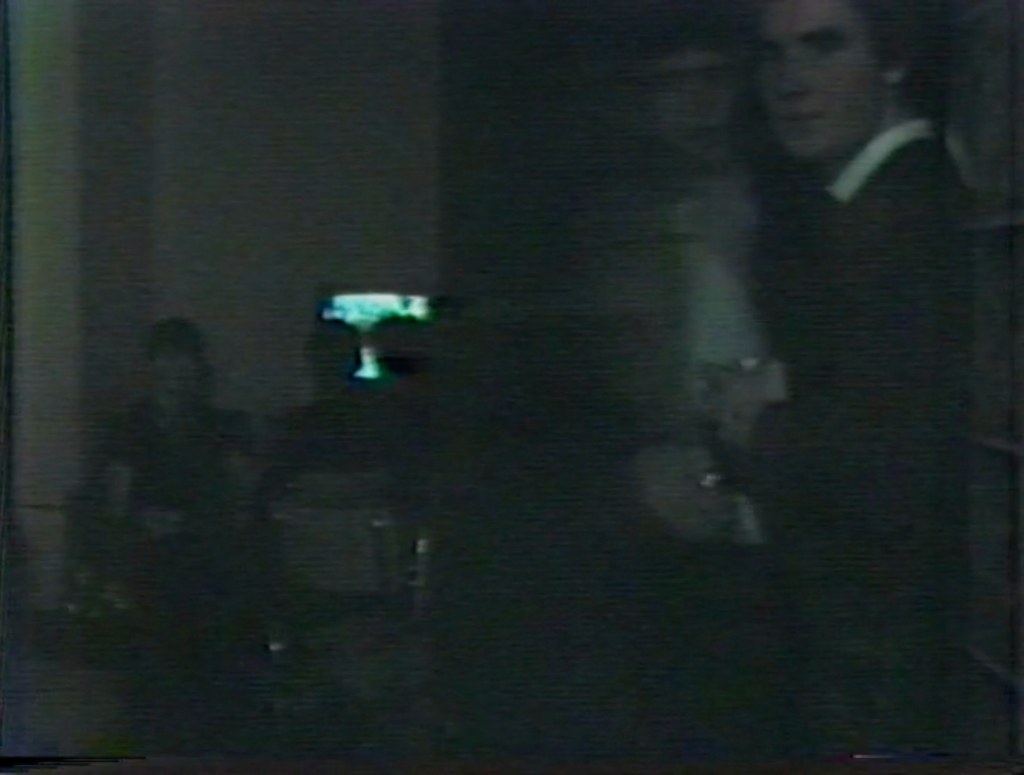
H.B.B: The film that led to this conversation, Making the Nature Scene (1985), emphasizes the importance of this porosity; the need for film screenings in clubs and engagement in contexts involving multiple disciplines. In the film, you wander through NYC Danceteria, a club on 21st Street that attracted figures like Basquiat and Haring and showcased a who’s who of great 80s acts, including Madonna, The Smiths, Run-DMC, Lounge Lizards, Sonic Youth, Nick Cave, Soft Cell, and Bauhaus, among others. Can you talk about this place?
K.G: Dancetaria was different from the other clubs because it had this megastructure idea of everything being in the same building. The ground floor was a space to play; this sort of big room. Most of the people were coming from New Jersey to dance there. The top floor was this cafe and video lounge where people hung out and just video monitors scattered around randomly. It was actually tacky, now that I think of it; the whole new wave-ish decoration. It was a time when video art and MTV was happening. I remember this night with Michael Gira from the Swans; he was kinda seeing Madonna, but would never say it. She was sitting on his lap, looking around for someone more important, I guess. It was funny. That’s my only brush with Madonna, really.
H.B.B: On what kind of occasion would you go there?
K.G: It would just depend on what band was playing.
H.B.B: New York is where, when you moved there in the early 1980s, you started doing music—even though you actually started when you were at Otis. At the very least, New York is where you felt the influence of people like Lydia Lunch, The Velvet Underground, Philip Glass, John Cage, Allen Ginsberg, and Andy Warhol. People who were actually not all musicians.
K.G : We had this noise garage band we made up for our Media Class.
H.B.B : Below the Belt, right?
K.G : Yeah. We played at this Film Festival, and this is where Mike Kelley saw us for the first time. It inspired him to start Destroy All Monsters. It’s funny. I arrived in New York later, where I was working a few jobs. Dan Graham was one of the first people I had met, through John Knight. He brought me to a concert. I think it was Theoretical Girls. I thought that this kind of music was much more interesting in a way than punk rock, because punk rock was still simply three-chord rock, in a certain way. This no wave music was much more fractured and free, and it seemed like it was really taking apart rock. Totally deconstructing. I was really drawn to that. Then Dan asked me to start an all-girl band for one of his performance pieces. Then I met Thurston through a girl, who I was playing with et cetera, et cetera, blah, blah, blah. (laugh).
H.B.B: (Laugh).
K.G: Music was, I guess, or became an escape for me because I got too close to the art world, when I was working at a gallery. The ’80s were really weird in the art world. It was when things were starting to become really commercial. A bit freaky. Everything turned to painting. The newer generation looked at what conceptual artists—people like Jack Goldstein—had done, while doing it within commercial systems; objects that would sell. It was a strange time, and I thought that music wasn’t part of that yet.
H.B.B: Which gallery were you working at?
K.G: I worked for Larry Gagosian as a receptionist.
H.B.B: Couldn’t be more central than that when it comes to the commodification of art during that period.
K.G: Right.
H.B.B: To me you are more of a conceptual artist who also does music. At least, I always understood your music in relation to conceptual attitudes. You also said that you wouldn’t consider yourself a musician.
K.G: I guess I consider myself an artist who makes music or an artist who writes. In the 80’s, I simply didn’t want to work with a gallery. The gallery system and all of that, you know. That’s when I started Design Office, and did these interventions in a few people’s apartments that I knew and then wrote about them. But it was more about being a psychological interior decorator becauseMusic was different, and allowed me to do differently.
H.B.B: Did you feel like a gallery was necessary?
K.G: I felt like that’s the art career you were supposed to have. I don’t know. Now I realize I have a career that suits me more. I wouldn’t be happy as a conventional artist. My ideal was more to have a show. And I actually had one, at White Columns.
H.B.B: In ‘Girl in a Band’, you mentioned that music was central to everything, both personally and artistically. Do you still feel the same way about music when you work on films, write, or paint? Is there a kind of ‘musical’ impulse in your creative process?
K.G: I just don’t think as much when I make music. I just do it. Whereas making art—visual arts—is a much more laborious act. I wasn’t trained in music; like a lot of people, I just fell into it. It appeals to the more visceral side of me. One thing I like about playing music is just moving through space, which sounds very Californian (laugh). Your electricity is an electric guitar is affected by movement in your relation to the amplifier and all that. I like it because at times you can really get lost in it. There’s no place to stay, so you have to move forward. And in art, it’s easier to get stuck or, for me, to become paralyzed. Don’t you think?
H.B.B: I don’t know. I don’t make music. But yeah; there’s a way of evolving through the stage that has this sort of immediacy that doesn’t exist—or cannot be manipulated—in other presentational contexts.
K.G: I was influenced by Warhol, and obviously The Velvet Underground—who I’d listen to when I was 14. One thing about pop art was about culture from the outside. Outside of the artist. In a way, having a band and playing within more mainstream situations—although Sonic Youth was never exactly mainstream—was the next step of that very same thing.
H.B.B: You are close to what German people call ‘Maskenfreiheit’; a freedom that is performed through masks. This has to do, again, with moving into different spaces. When I worked on this interview, I realized that I was quoting a lot of males. And as a matter of fact, you were surrounded by many. We named them; Graham, Kelly, Knight. Being under that specific influence also questions the masks we use.
K.G : That’s true. I never thought about that.
H.B.B: Being this girl in a band, actually; the name of your autobiography. Something that you also mention in Trash Drugs and Male Bonding, or in your closeness to the Riot grrrl.
K.G: I have a band with all girls, now (laugh).Which was accidental, actually.
H.B.B: No-wave has often been associated with Sonic Youth. However, in reality, Sonic Youth drew from it without fully embracing no-wave. I feel that it’s your visual art that has consistently aligned with this attitude, this anti-wave.
K.G: Right. Well, it was over. The scene was ending. It was much more nihilistic than Sonic Youth. We were definitely influenced by Glenn Branca, who used shitty guitars, and tuned differently. I did this series of names of noise bands on paintings. I liked the idea of taking something really obscure and giving it a different use function by putting it unto painting. Much like someone buying a T-shirt from a place they’ve never been to.
H.B.B: Like all these people wearing this Sonic Youth t-shirt without listening to Sonic Youth (laugh).
K.G: (laugh) Or walking around wearing a Nirvana shirt.
H.B.B: You also frequently wrote; on art—I have in mind this piece on Mike Kelley for Artforum—but also music. Can you tell me more about your relationship to writing; and more specifically theory?
K.G: I’m not really academic or anything. I was just trying to think of preposterous premises and then try to prove them a lot of times. But just writing for me is how I can think. I can’t really think unless I’m writing. I’ll read something I wrote a long time ago and go, Wow, did I write that? I don’t know if you ever have that experience?
H.B.B: I approach writing as a sort of mechanism. A sort of painful one. Something that Dereck McCormack described as the devotion to disgust; ‘I can’t conceive of writing without disgust as the driving force – and as the desired effect. Writing is devotion to disgust’. ✦
Kim Gordon (b. 1953) is an artist, musician, and performer. She is based in Los Angeles. She studied at the Otis Art Institute in Los Angeles in the late 1970s and has continued to work as an artist ever since. Her first solo exhibition, presented under the name ‘Design Office,’ took place at White Columns in New York. Over the past three decades, Gordon has worked consistently across disciplines and distinct cultural fields; as a founding member of X-Girl, Sonic Youth, Free Kitten, and Body/Head.