Pier 52: Alvin Baltrop, Gordon Matta Clark, David Hammons
Hugo Bausch Belbachir
The dimensions of Day’s End, David Hammons’s sculptural intervention at the end of Gansevoort Street in New York, are identical to those of Pier 52, a warehouse demolished in 1979 on the very same site. Directly inspired by the eponymous intervention of Gordon Matta-Clark—which, over the course of several months during the summer of 1975, consisted in the execution of five incisions into the warehouse’s architecture, creating a constellation of openings that linked the building’s interior to its exterior—Hammons’s installation functions as a direct homage to Matta-Clark’s final chef-d’oeuvre. Faithfully reproducing the measurements of the original edifice, Hammons’s Day’s End reanimates an lesser-known intention of Matta-Clark’s to establish the Pier’s symbolic death: of what he and his collaborators considered a deserted ruin in 1975, but was, in fact, a known living habitat of a queer, Black, and unhoused community that, throughout the early 1970s, had initiated an autonomous space for self-determination.
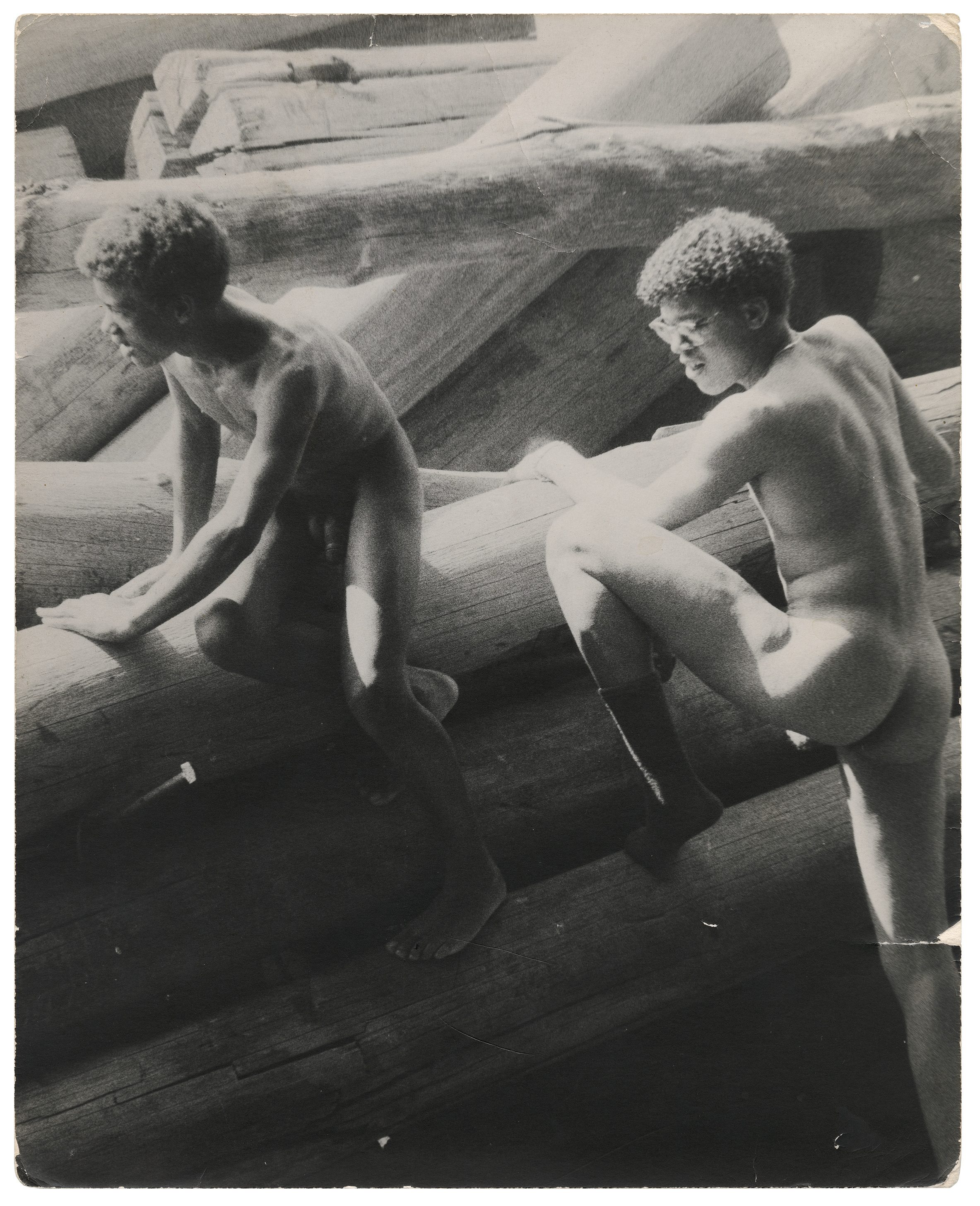
After the collapse of the elevated section of the West Side Highway in 1973, the piers became the stage for an ephemeral architecture dedicated to homosexual existence, serving as spaces of rest, sunbathing, and wandering, and becoming sites of encounter and confrontation between self and other, in the fleeting intimacy of anonymous sexual exchanges. Located behind the debris of the collapse—through which one had to cross heaps of metallic debris scattered along the road before entering the abandoned warehouses and docks—the place, whose very isolation from the world enabled it to fashion itself as that world’s antithesis, enabled an entire generation to live out experiences otherwise forbidden to them in the social realm; intricate architectural labyrinths composed of corridors, vast enfilades of rooms, staircases, elevators, doors, and windows, all contributing to an experience of drift, play, and secrecy.
From 1975 to 1986, Alvin Baltrop continuously photographed these warehouses, producing thousands of negatives that now constitute his primary photographic legacy. It was Alice Austen, his lover at the time, who encouraged him to explore these sites. Determined to spend as much time there as possible, Baltrop left his job as a taxi driver to work as an independent mover, purchasing a small van in which he would remain, days and nights on end, waiting for something to happen. He later wrote:
“Although initially terrified by the piers, I began taking these pictures as a voyeur [and] soon became determined to preserve the frightening, crazy, incredible, violent, and beautiful things that were happening then. For some shots, I hung myself from the ceilings of warehouses using a makeshift harness, watching and waiting for hours to record the lives of those people (friends, acquaintances, and strangers) and the tragic ends they sometimes met. Casual sex and drug use, the creation of art and music, sunbathing, dancing, rejoicing, etc., would often give way to assaults, detached yet senseless violence, rape, suicide, and, in some cases, murder. The rapid appearance and spread of AIDS in the 1980s further diminished the number of people who frequented and lived on the piers, as well as the fleeting joys that could once be found there.” (1)
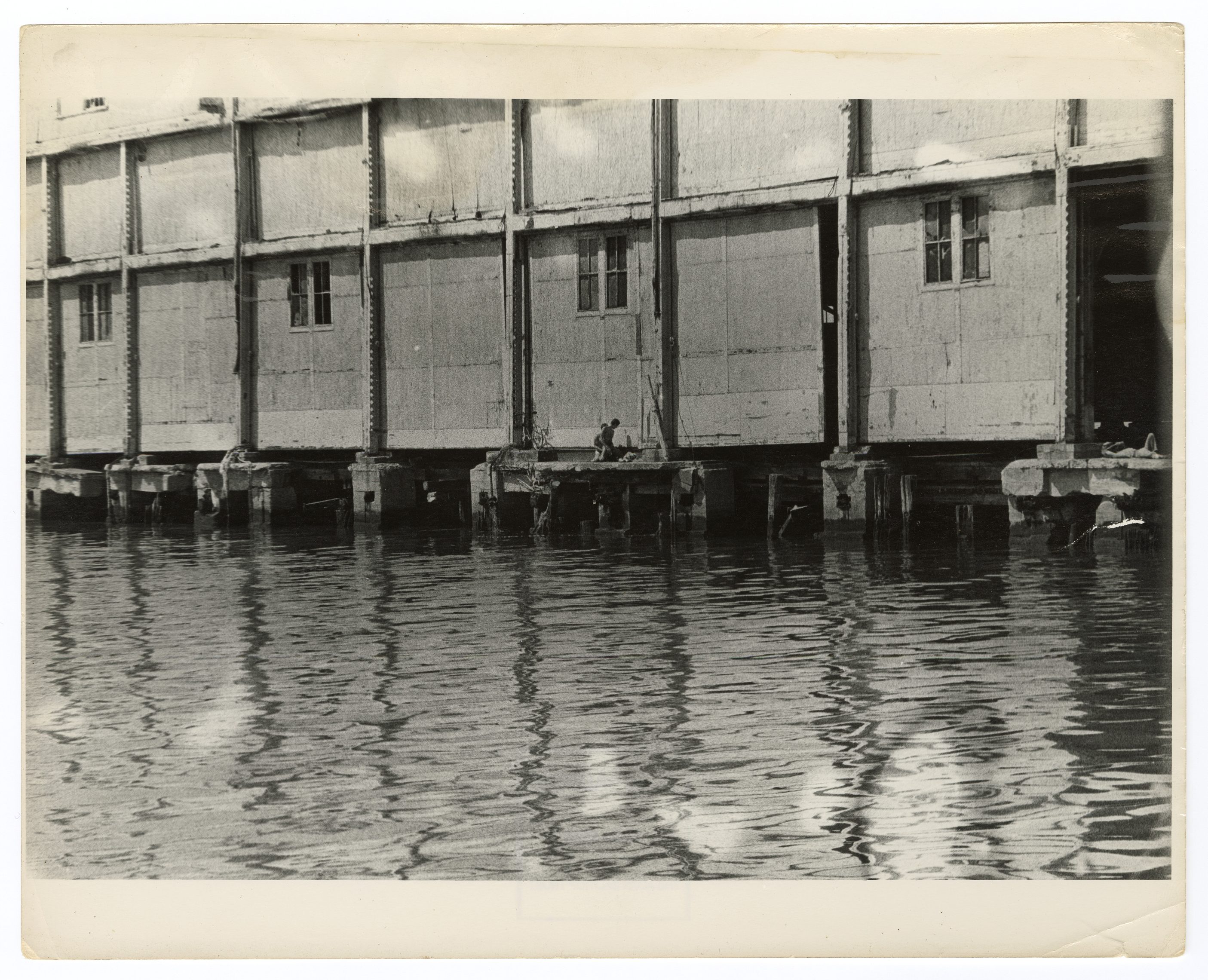
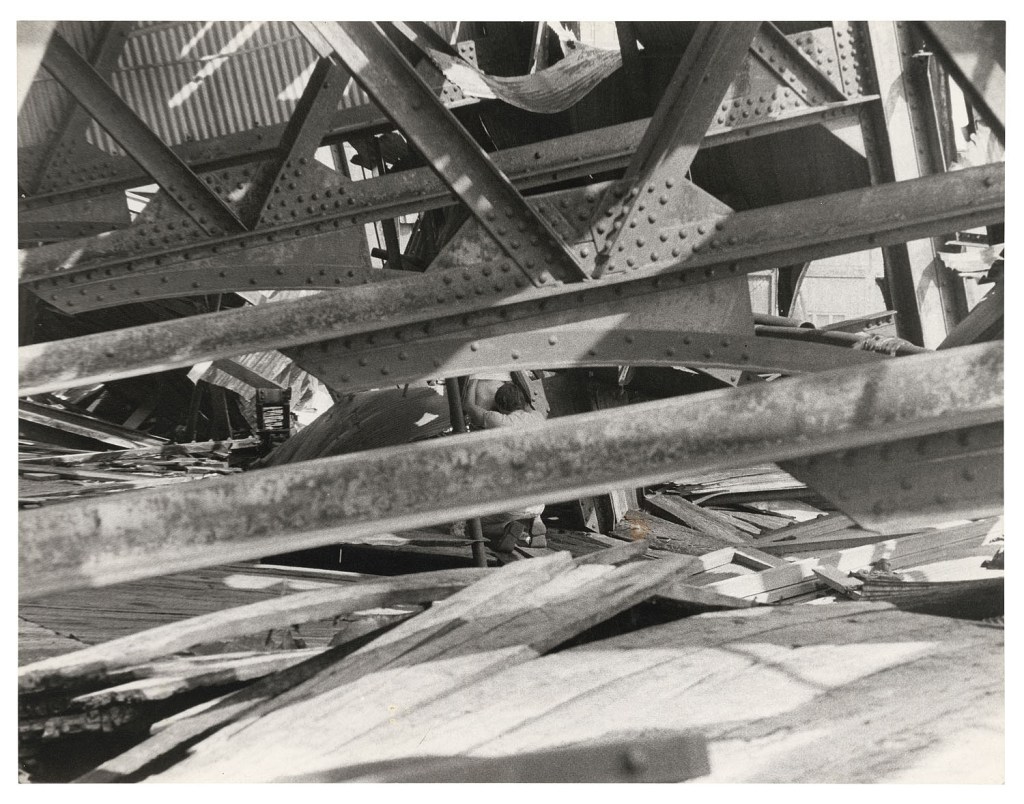
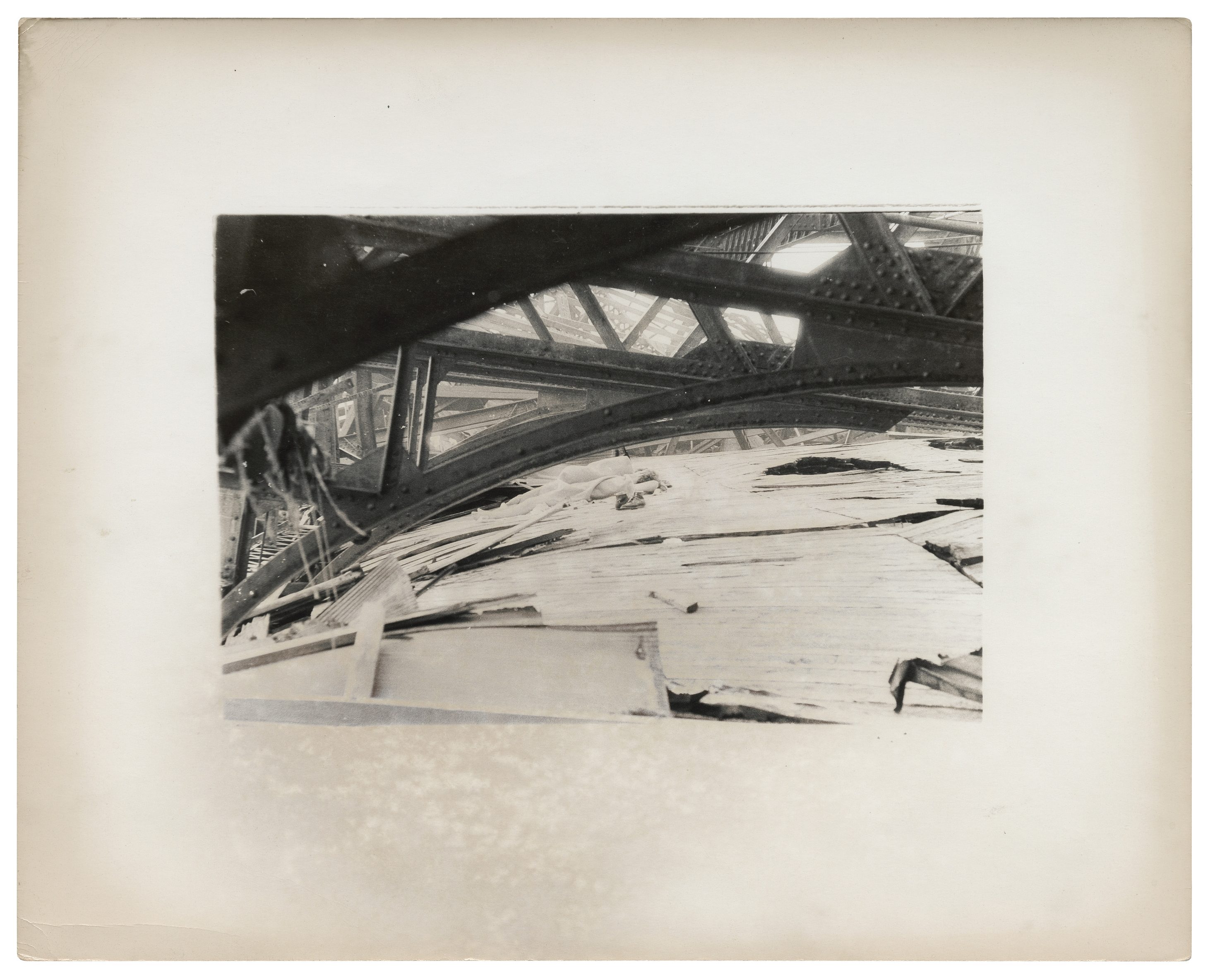
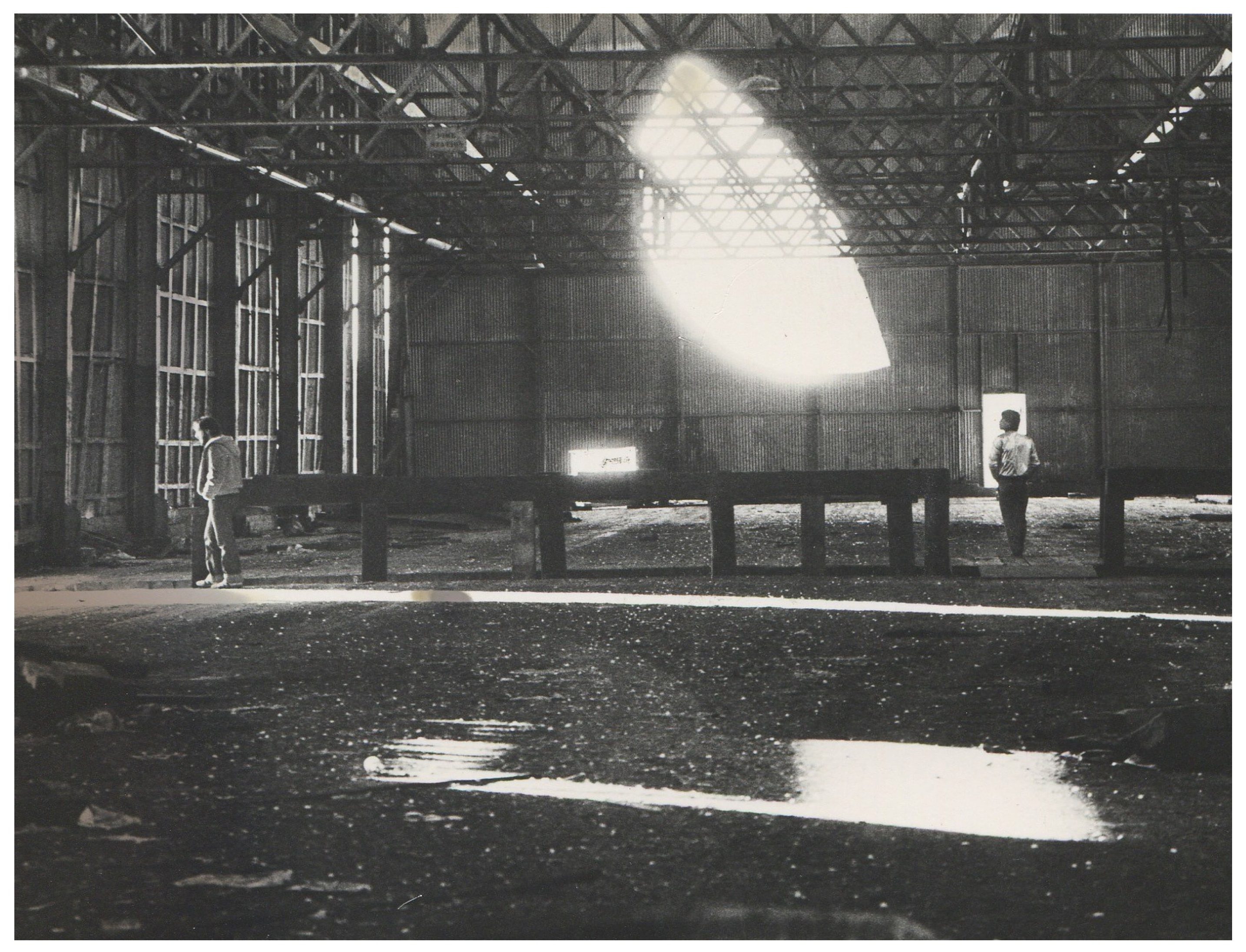
Several of Baltrop’s photographs bear witness to Gordon Matta-Clark’s intervention at Pier 52. Standing as one of the artist’s most significant projects—arguably his most celebrated, and the one for which he is most often remembered, despite the fact that very few people ever saw the work, apart from those directly involved in its making—Day’s End was conceived over the course of the summer of 1975, originating from an idea of a “sun-and-water temple” (2) . In preparatory sketches, Matta-Clark began with the use of symbols such as the hammer and sickle—the hammer of the industrial proletariat and the sickle of the agricultural one, joined in revolutionary solidarity—to delineate the cuts he intended to make in the structure of the warehouse itself. Initially titled “Day’s Passing,” the work was conceived as a direct response to the architecture of Pier 52, considered by the artist as the “last relic” (3) of New York’s East River dockside warehouses. The project encompassed two main sections of the building: the first consisted of a series of incisions through the roof, thin walls, and thick wooden flooring, creating a three-meter-wide opening and a “river door” cutting across the center of the pier; the second focused on the western extremity facing the river, where large arches were carved into the surface and walls, working together to form a spherical quadrant. Within this dark, basilica-like space, these openings orchestrated an interplay between the sun’s daily passage and the ebb and flow of the river’s tides below.
Matta-Clark’s artistic self-interest defined most of his efforts to “free these spaces for a healthy, clean, and meaningful public use” (4), and places like Morton Street, Fulton Street, and subsequently the piers, for the artist, symbolized the city’s abdication of public use and, consequently, the necessity for his agency to reclaim authority over them. The same year, he wrote:
“Since most, if not all, of the terminals that are no longer in use have been left wide open, without ‘No Trespassing’ signs or any public warnings whatsoever, one might think that a state of anarchy tolerated by the city prevails there. In such a situation, it would seem within the rights of an artist—or anyone else for that matter—to enter such premises with the desire to improve the property, to transform the structure, in the midst of its criminal and ugly condition, into a place of interest, fascination, and value. Moreover, given the obvious signs of neglect, there is no reason for such a person to imagine that any owner remains interested in the property; it is merely an abandoned terrain in need of cleaning and redevelopment for a more positive and possible use. Given the prevailing conditions and the specific circumstances at play in a place such as Pier 52, I find only good in the conversion of that site into a work of art—a sculptural festival of light and water—carefully secured and open to the public for their enjoyment, rather than leaving it a derelict waste. In my final analysis, such an act is not only defensible but would constitute a valuable contribution to the inhabitants of New York City.” (5)
Matta-Clark died in 1978, at the age of thirty-five, and Pier 52 was demolished the following year. The demolition order coincided with broader city-measures aimed at criminalizing homosexual spaces at the height of the AIDS epidemic. Matta-Clark’s project, through Day’s End, had already engaged with an ideology of erasure, in the demolition of landscapes belonging to queer, marginalized lives. In the same notes written in 1975, the artist insists on the necessity to make of the warehouse a “place of interest,” seeking to “transform its value,” perceiving Pier 52 as the outcome of the city’s disinterest and the “anarchy” of an “ugly and unsightly” place:
“Apart from my personal feelings regarding the catastrophic management of the declining port and its ghostly terminals, there is the inextricable evidence of a new criminal situation of alarming scale, the waterfront has probably never been anything but a dangerous place, but now, with this long period of slow transition, it has become a genuine playground for thieves, both for those who come merely to stroll and for a recently popularized fringe of sadomasochists.” (6)
It is instructive to read Matta-Clark’s text as his justification for the realization of Day’s End. Matta-Clark does not merely aim to describe an abandoned architectural site; rather, he seeks to engage with it in a way that enables its ideological reappraisal and redefinition. The use of “criminals” and “sadomasochists” cannot, as well, be dismissed as incidental: in the United States of the mid-1970s, homosexuality and other queer sexual practices bore heavy social and legal consequences, with homosexuality—especially when expressed outside bourgeois milieus—being systematically criminalized and cast as deviant under repressive legislation and pervasive social stigma. Gay individuals were beaten to death. Later, hundreds of thousands of people would die of AIDS, in a global political silence that will condemn them precisely for being gay. Within such a climate, the association between homosexuality and criminality is far from exceptional, for any homosexual act, whether public or private, is liable to be deemed illegal. It is therefore essential to situate these terms within their historical and sociopolitical context, and Matta-Clark’s application of these labels to the inhabitants of Pier 52—principally Black, trans, homosexuals, as well as sex workers—thus reflects and participates in a broader, fascistic ideological apparatus for their exclusion and consequential death.
Through the incisions within the warehouse’s architectural structures, Gordon Matta-Clark enacted a total—both structural and ideological—transformation of the site, redefining its capacity to serve as a space of anonymity. During the cutting of the openings, Matta-Clark had the warehouse closed off, complaining about the comings and goings and the sexual activities taking place inside. By opening the structure to the outside—bringing light into a place that had managed to exist precisely because it was hidden, immersed in total darkness—the artist intervened according to his own political justification. No document or testimony attests to any conversation between the artist and the inhabitants or users of the site. Nor does any statement by Matta-Clark suggest an interest other than that of acting in direct opposition to them—“requiring cleaning and redevelopment for a more positive and possible use”—or an awareness of the pier as one of the few spaces in which a free queer experience could be lived. “The only way to proceed,” he wrote, “was to take possession—to occupy and possess.” (7)
The echoing sculptural intervention conceived by David Hammons and commissioned by the Whitney Museum of American Art, unveiled in 2021, is, as structure, primarily existing in the suggestion—or memorial—of the Pier 52, through the spectral suggestion of its frame. Rising from the remaining beams of the original building, still visible at the water’s edge, the work’s structural capacity, limited to the mere suggestion of the hangar’s formal outline, lies in its very interest in being a monument to Gordon Matta-Clark’s Day’s End. Through its title, Hammons’s own Day’s End mirrors and doubles Matta-Clark’s political dream; the appearance of the monument, stripped bare, merges with Matta-Clark’s intention to expand the building outward, and against its original safe secrecy. In Hammons’s hands, Day’s End dissolves entirely into the surrounding environment—no longer a site of hidden sanctity, but a spectral and open monument where memory, visibility, and absence are supposed to coexist. And if the discursive components of David Hammons’s early works—site-specificity, urban actions, outdoor interventions, and the immediacy of their experience by the community surrounding these sites (Blizzard Ball Sales, 1983; Pissed Off, 1980, etc) can be read in adjacency to the work of Gordon Matta-Clark (Food, 1971; Splitting, 1974), it is important to underline that, in contrast to Hammons’s practice, Matta-Clark’s works never articulated any considerations of race nor gender. And by intervening, in 1975, within the inside of Pier 52, preventing any individuals outside his own from entering, Matta-Clark, as an artist, existentially negated the necessity of these very notions—race, gender—to exist within an artistic discourse.
The Piers along the waterfront were the site of a political community criminalized because it was deemed criminal. One defined by sexuality, gender, class, race, as well as ones in need of anonymity, refuge, memory, and honest expression of the self. The Piers constituted the most politically charged spaces in Manhattan, and in the freest era in gay history, spanning from 1969 sexual revolution to the onset of the AIDS crisis, in 1981. From this emerged forms of true artistic engagement questioning traditional modes of representation, and shaped toward visual and ideological confrontations through practices of orality, writing, communal gathering, occupation, and dissemination. It was common, in the mid-1970s, to encounter figures David Wojnarowicz at Pier 34, or Peter Hujar. The experience of community is absent in Matta Clark’s Day’s End. Entirely. It is absent precisely as it is opposed to everything that had shaped the ideological use of the Pier 52 as an autonomous, activist, and political shelter: by incising the walls and floors of the Pier, Matta-Clark rendered it, altogether, uninhabitable. Day’s End effectively disregarded the architectural conditions that had allowed Pier 52 to function as a site for wandering, anonymous homosexual encounters and for the cultivation of an autonomous, secret queer life, exposing these practices, in the opening of the structure of the building to the outside—rendering their existence impossible; once made legible, they were, in effect, prohibited again. Once finished, Matta-Clark never returned to the site: indeed, he had never visited it beforehand, having had no necessity to live outside of his given existential advantages.
The notion of community is central to the corpus of thousands of photographs produced by Alvin Baltrop from the mid-1970s through the mid-1980s, in which Pier 52 played a central site not only for Baltrop’s work, but life. The artist began by visiting it occasionally, parking his small moving truck to photograph the building from the outside, gradually venturing inside, to later eventually living there to some extent. His participation—evolving from that of a distant observer to a photographer working in increasing proximity to his subjects, ultimately implying his own involvement in the life occurring there—doubles his position as both photographer and subject within his own work. In a box discovered after his death, a set of documents was found in which Baltrop had written down questions for the teenagers who lived at, or regularly frequented, the Piers. These individuals came from the poorer districts of the city and its outskirts and gravitated naturally toward the Piers as the sole place where the expression of their desires was possible: “Do you know what I am doing and why I am doing it? Do you know the answer or have you already formed one?; Why did you call?; What prompted you to go upstairs?; Black and white issues: notes on race, general physical description.; What brought you to the piers?; What was your usual routine while at the piers? Details: what, when, where, etc.; Did you develop long-term friendships, lovers, connections, or regular acquaintances at the piers?; How old were you the first time you had sexual relations; homosexual sexual relations? Did you think it was homosexual sex?; Describe your life outside the piers, while you were at the piers, the only place to socialize and have sexual relations.; Describe your family, now, then, and during your coming-out process.; Are you currently in a long-term relationship? Describe it: duration, sexuality.; Are you HIV-positive? How has that affected your life and sexual life?; Do you have one or two special memories of the piers? Describe them in detail.; How do you dress to go to the piers? What types of men, activities, scenes attracted you?; Describe the people you see on the piers.; Others have spoken of the smell or the sensation of the piers.; Did you talk to your friends about the piers? What did you say, and what did they say?; Please look at this photograph. What is your reaction? Does it belong to your environment?” No completed responses to these questionnaires exist in the Baltrop archives today. Yet it is evident that Alvin Baltrop asked these questions during the hundreds of portraits he produced at the time, mostly of adolescents. In his notes, he wrote:
“I saw a car pull up outside the pier. An older, heavyset white man reached out of the car, pulled two boys out, took two shopping bags, and threw them on the ground. He slapped them both in the face and said, ‘I have no faggots in my home. Nor in my family. Don’t come back. You are no longer my sons.’ He threw them out on the street, threw their bags with their clothes, got in the car, and drove away. Both kids just sat on the edge of the pier, crying. They were scared and didn’t know what to do. They didn’t know where they were—at the pier on the west side, Pier 57 or 58, to be exact. They went inside with their bags, just trying to collect themselves and decide what to do next. Another kid who had seen the whole thing came over and said, ‘You’re not from here—I’m going to show you how to survive here. You can get fresh water over there, take showers over there, use that room as a bathroom. My tent is under here; when I’m not in it, you can use it to sleep.”
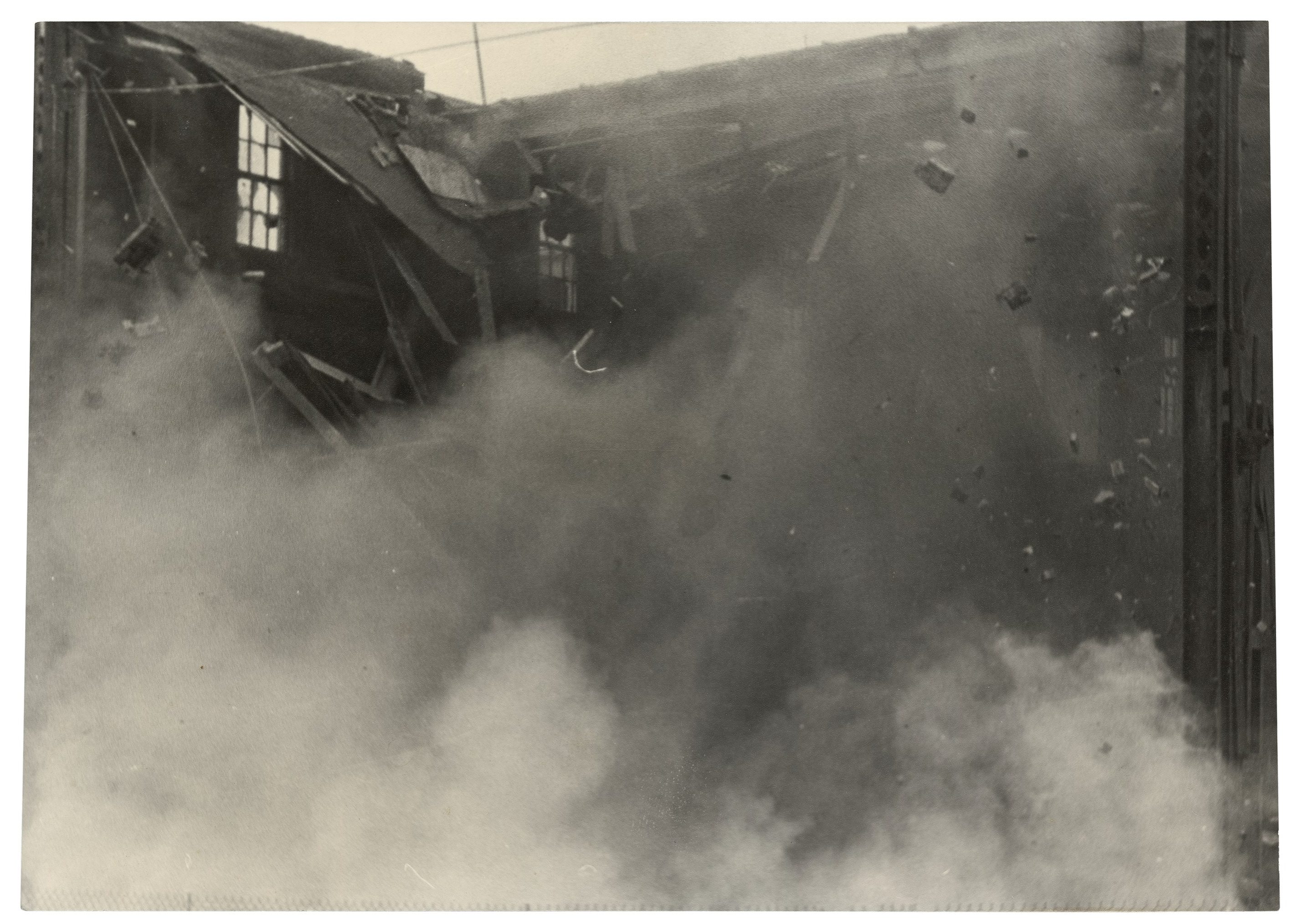
In the following years after Day’s End, the Waterfront warehouses were demolished, and the ruins of the West Side Highway were cleared for a new highway. Baltrop produced hundreds of photographs of the Piers in destruction, whose bare structural elements ultimately resemble, ironically, the visual result of Hammons’s sculptural intervention in homage to Matta-Clark. In a photograph by Andreas Sterzing, Pier 34 Demolition, the drawing David Wojnarowicz’s Gagging Cow—created as part of his vast, collective Pier 34 project—appears in the shadow of the building being torn down. The entire work is visible from the outside, through an opening carved into the structure. The photograph possesses a distinctive, unsettling violence. Homeless gay men and sex workers who lived in the Piers were forced to leave. Many friends were lost. The early AIDS epidemic claimed numerous friends, including Baltrop’s lover, Alice. He then encountered a new generation of young gay men, lesbians, and transgenders rejected by their families and living on the streets. Drawing on his medical and military experience, Alvin offered assistance, distributing condoms, recommending over-the-counter medications, and providing compassionate guidance. He hoped to establish a community space to teach photography to marginalized youth, shortly before becoming sick himself. He died in 2003, at age 56. ✦
1) Baltrop never had the means to print the vast majority of the photographs he took on the piers, nor to properly care for the ones he did manage to print. When Baltrop learned he had cancer in the late 1990s, he began working on a book of his pier photographs, a project that occupied him until his death in 2004. This text is the introduction to that unfinished volume, which I consulted at the artist’s archives in Red Hook, Brooklyn (NY), in 2024.
2) Gordon Matta-Clark, « My Understanding of Art, » 1975, typewritten statement, in Gloria Moure (ed.), Gordon Matta-Clark: Works and Collected Writings, Ediciones Polígrafa, Barcelona, 2006.
3) Ibid.
4) Ibid.
5) Ibid.
6) Ibid.
7) « I should start by explaining how this came about. I mean what it’s like to wander around New York for months trying to find a space to do work, and especially something on the scale of what I’d been able to do in other places, but not in New York. I spent six months writing and talking to people who told me they didn’t really know how to help me, or how to get permission from anyone, except through some kind of private real estate company. (…) Originally I had thought about facades, because when you go down the pier, along the empty highway, the facades are incredible, a lively grouping of different eras and different personalities. I wanted to focus on one of the early ones, which is a turn-of-the-century facade. There’s a kind of classicism in the tin. And cut the facade. The ones I originally found were all completely overrun by gay men. And S&M, you know, that whole S&M shadow of the waterfront. (…) Originally it was about cutting slices or wedges out of New York’s empirical waterfront — not the empirical waterfront, the imperial waterfront of New York. So I thought that since the pier belonging to the American Railroad, a nineteenth-century robber baron, had carved up American businesses and America, properties across the whole country, it would be fitting to take a pie-shaped slice of it. (…) After searching the whole waterfront for a pier, I stumbled upon this one. And of all of them, it was the least frequented. It had been broken into and continued to be while I was there. But it was something of a step away from their usual haunt. So I went in and realized that with little effort I could secure it. And it occurred to me that while I was plugging up the holes and putting barbed wire on various parts, I would also change the lock and have my own lock. It would be so much easier. I wouldn’t have to climb over anything or do anything — so I put my own lock on. (…) The only way to go about it was to take possession — to occupy and to own. » See: « Gordon Matta-Clark: The Making of Pier 52. An Interview with Liza Bear, March 11, 1976, » in Gloria Moure (ed.), Gordon Matta-Clark: Works and Collected Writings, Ediciones Polígrafa, Barcelona, 2006.
All images courtesy of The Estate of Alvin Baltrop/ Third Streaming, New York, and Galerie Buchholz.